
Shame Doesn't Discriminate
How compulsory sexuality creates shame in both the presence and absence of desire

How Compulsory Sexuality Creates Shame in Both the Presence and Absence of Desire
There is a societal belief known as compulsory sexuality, a term inspired by Adrienne Rich’s 1980 essay Compulsory Heterosexuality and Lesbian Existence and developed by writer Sherronda J. Brown, author of Compulsory Sexuality. Brown defines compulsory sexuality as “the societal belief that sexuality is something we are obligated to participate in—that everyone desires sex, and that it is normal, healthy, and required to have sex.”
At its core, compulsory sexuality rests on the assumption that all humans do and should experience sexual attraction. Its harmful effects are perhaps most visible among asexual people—through pathologization, the erasure of asexuality as a legitimate sexual identity, and pressure to engage in sex despite a lack of desire. However, you do not need to be asexual to be impacted by compulsory sexuality.
Compulsory sexuality functions as a deeply sex-negative social force. It fails to recognize sexual diversity, undermines the freedom to choose a sex-free life, and creates profound shame around opting out of sex—temporarily or permanently.
While shame around sex is often associated with the desires we do have—especially when they’re kinky, non-normative, or taboo—many people experience shame around the absence of desire or sexual activity. This is particularly true for asexual people and those who experience lower or fluctuating desire.
Though shame can be destabilizing and frightening, it can also serve as a messenger. When met with curiosity rather than judgment, shame can point us toward greater self-awareness and authenticity in our sexual and relational lives. This requires questioning the social scripts rooted in allonormativity—the assumption that everyone experiences sexual attraction and should act on it.
Shame in the Absence of Desire
Where does shame around low or absent desire come from?
Is it because we’re expected to experience sexual attraction?
Because relationships are presumed to include sex?
Because couples are “supposed” to have sex at a certain frequency to be considered healthy or successful?
Whose expectations are informing our beliefs about sex, desire, and intimacy?
This is where my work lives: helping people examine the roots of pressure and expectation, and supporting them in releasing those inherited scripts. Liberation can look like choosing sex—or choosing not to have it—and both are equally valid.
Sex Isn’t the Only Pathway to Pleasure
As a coach, I do not operate within the framework of compulsory sexuality. I am not here to tell you to have more sex. I am here to support you in exploring your relationship to your sexual identity, orientation, and expression—whether that includes sexual attraction, desire, activity, or none of the above.
Intimacy exists on a spectrum. Relationships can take countless forms, structures, and constellations. Pleasure can—and does—exist outside of sex, desire, and romance.
You get to choose what threads you weave into your relationships, whether romantic, platonic, sexual, or something else entirely. In my practice, honoring non-sexual forms of intimacy is central. I celebrate working with asexual folks and people of many sexual orientations who want to explore intimacy in its full range: intellectual, emotional, spiritual, experiential, and physical.
I’m here to support your exploration, affirm your agency, and hold compassionate space through both the joyful and tender moments that arise along the way.
Embracing Freedom
You have the freedom to decide whether or not you want to have sex. No one else gets to make that choice for you.
Your sexual identity, orientation, and expression—whether you’re questioning, coming out, navigating complexity within a relationship, or trying on different labels—are worthy of care, respect, and pleasure.
You get to define your sexuality on your own terms.
That includes having as much sex as you want, as little as you want, or none at all.
You’re Invited! 💌 Real Talk with The Sexperts: Let’s Talk About Coming Out

Welcome back to Real Talk with the Sexperts!
In this live Q&A panel, we’ll explore the complexities and joys of coming out. Coming out is not a one-time moment, but a deeply personal journey of self-discovery, courage, and choice.
This conversation makes space for the messy, non-linear truths of queerness — including coming out later in life, second adolescence, bisexual and fluid identities, mixed-orientation relationships, and more. Together, we’ll unpack layers of identity, visibility, shame, and pride, honoring both the tenderness and the triumph that come with embracing our truth and living authentically.
✨ FREE & VIRTUAL ✨
🗓 Tuesday, December 16
⏰ 6:00–7:00 PM ET / 3:00–4:00 PM PT
How might your relationship with self or others look different in 2026?
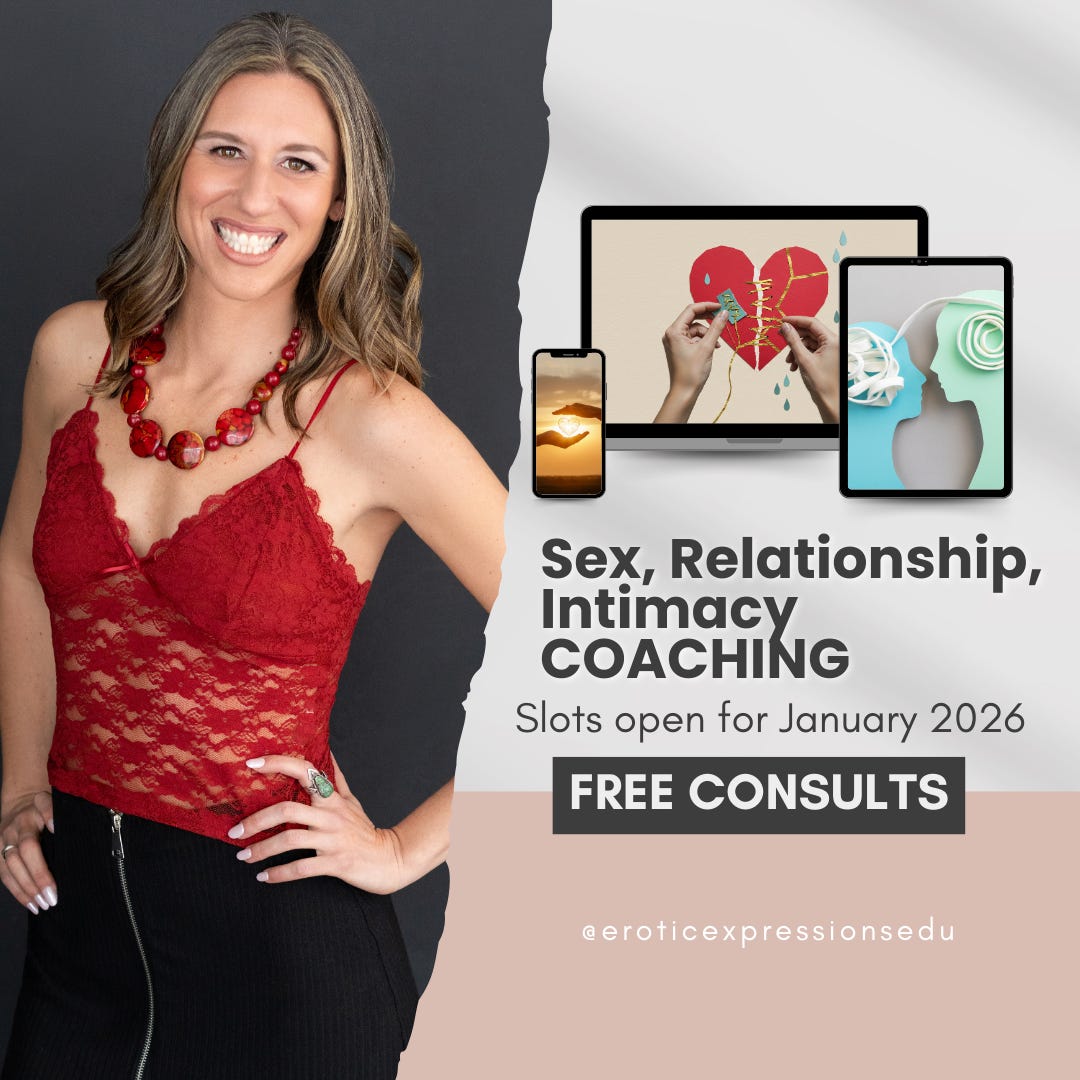
If you gave yourself permission to grow, how might your relationship with others or yourself evolve by 2026?
Now is the perfect time to reflect on the year and set intentions for 2026. Working with a coach can offer multiple benefits: education, accountability, compassionate guidance, unwavering support. Here are some FAQ’s I receive about coaching.
Coaching FAQs
What is relationship & intimacy coaching?
Coaching is a collaborative, forward-focused space to explore desire, communication, boundaries, pleasure, and patterns—while building practical tools for the relationships and intimacy you want now and, in the future.
How is coaching different from therapy?
Therapy often focuses on healing past wounds and addressing mental health diagnoses. Coaching centers on the present and future, emphasizing growth, choice, skill-building, and embodied practice. Coaching does not diagnose or treat mental health conditions.
Can I work with both a therapist and a coach?
Absolutely. Many people find coaching and therapy work beautifully together. Therapy supports healing; coaching supports integration, experimentation, and intentional change in daily life.
Do you work with individuals or couples?
Both. I work with individuals, partners, and relationship constellations of all kinds—including monogamous, non-monogamous, queer, questioning, and mixed-orientation relationships.
What kinds of topics do clients bring to coaching?
Desire discrepancies, shame, pleasure, communication, coming out, identity exploration, relationship agreements, boundaries, non-monogamy, intimacy after change or transition, and reconnecting to joy and agency.
What makes your coaching unique?
My work is pleasure-positive, anti-shame, identity-affirming, and non-prescriptive. I blend somatic awareness, curiosity, and practical tools—centering your autonomy rather than “shoulds,” scripts, or one-size-fits-all relationship models.
Is coaching right for me if I’m not sure what I want?
Yes. Coaching can be especially helpful when you’re in a place of questioning, transition, or expansion. You don’t need clarity—you need curiosity.
How do I get started?
Begin with a free consultation to explore your goals, ask questions, and see if we’re a good fit.
Micro-Moment of Embodiment ✨
Put on some music.
Dance it out.
Move your body.
Let go of expectations of how you should look and feel.
Start now 🎶